AI Automation for Businesses: Save Time & Increase Profit

Credentials: Core engineering team specializing in enterprise architecture, Next.js, and cloud automation.
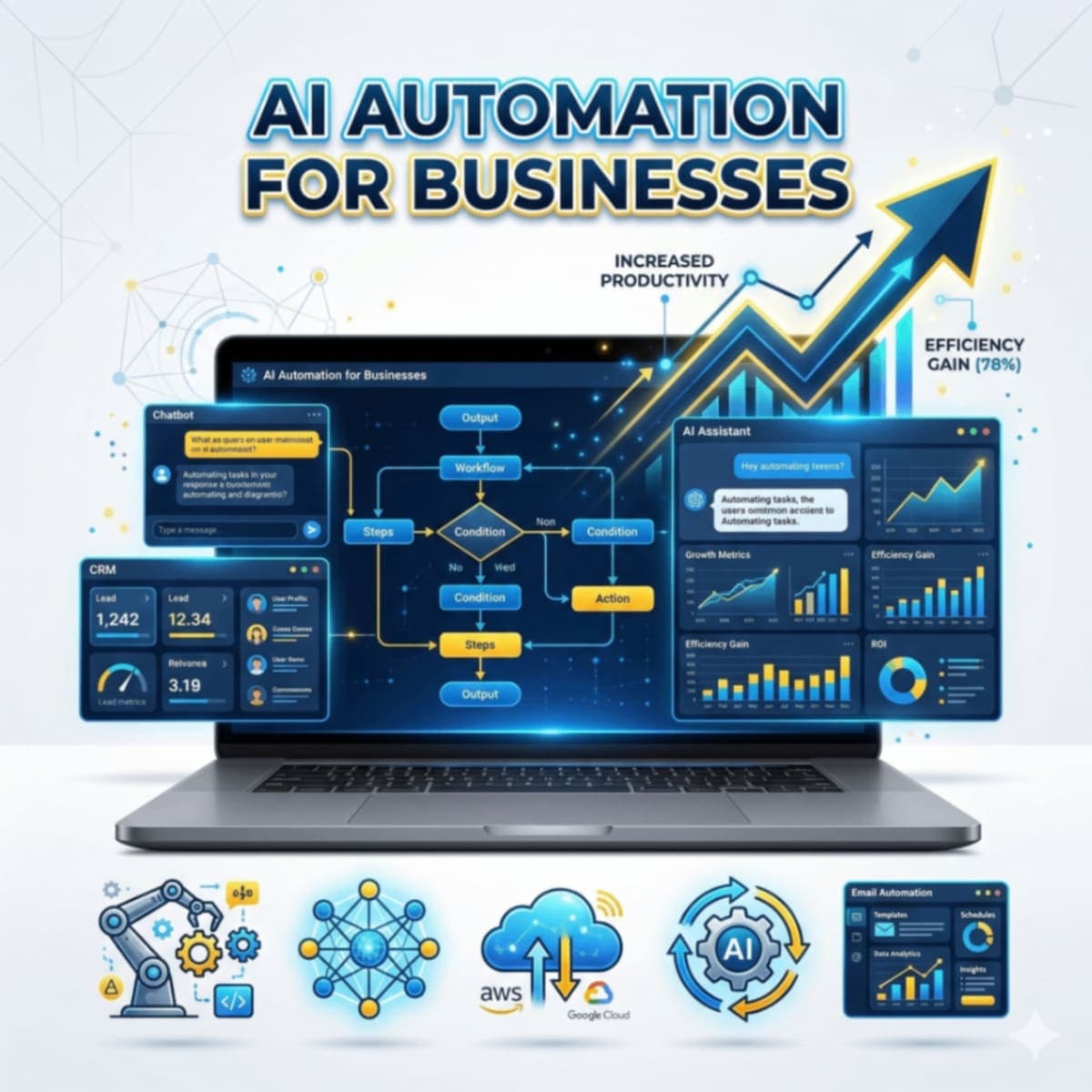
Adopting ai automation for businesses has become the defining factor for operational excellence in 2026. As markets evolve, the integration of ai automation for businesses allows organizations to eliminate bottlenecks and scale with unprecedented precision. The era of manual data entry and repetitive administrative tasks is over, replaced by intelligent agents that learn and adapt to your specific workflow needs. At Zynocode, we have observed that companies leveraging these technologies see a significant reduction in operational overhead while simultaneously improving customer satisfaction scores through faster response times and hyper-personalized service delivery.
Why AI Automation for Businesses is Essential in 2026
The competitive landscape has shifted toward a model where speed and data accuracy are the primary currencies of success. Organizations that fail to integrate intelligent systems find themselves struggling with rising labor costs and human error, which can be catastrophic in high-stakes industries. According to data from Statista, the global AI market is projected to reach over $1.8 trillion by 2030, highlighting the massive capital being poured into these transformative technologies. This investment is not just for tech giants; small and medium enterprises are now utilizing AI Tools & Automation to compete on a global scale. By automating routine decision-making processes, leadership teams can refocus their energy on high-level strategy and creative problem-solving rather than getting bogged down in mundane daily operations.
Furthermore, the availability of specialized software development frameworks has made it easier than ever to build custom wrappers around Large Language Models (LLMs) that are fine-tuned on proprietary company data. This ensures that the automation is not just a generic tool but a specialized asset that understands your brand voice, customer history, and internal protocols. In 2026, the distinction between a 'digital business' and a 'traditional business' has vanished; every successful entity is now an AI-driven entity at its core. Whether you are managing a logistics fleet or a digital marketing agency, the ability to process vast amounts of data in real-time is the only way to maintain a sustainable competitive advantage.
Core Benefits of AI Automation for Businesses
The primary advantage of implementing ai automation for businesses lies in the dramatic increase in operational throughput. Unlike human employees who require breaks and are subject to fatigue, AI-driven workflows operate 24/7 with consistent precision. This is particularly evident in customer support, where AI agents can handle thousands of simultaneous inquiries, resolving common issues instantly and only escalating complex cases to human representatives. This hybrid approach ensures that your web applications development projects are supported by a robust infrastructure that never sleeps, providing a seamless experience for your global user base.
Another critical benefit is the enhancement of data-driven decision-making. AI systems can analyze patterns across millions of data points in seconds—something that would take a human team weeks to accomplish. This capability allows for predictive analytics, where businesses can forecast demand, identify potential churn before it happens, and optimize pricing strategies in real-time. For companies focused on growth, integrating these insights into your SEO & Digital Marketing strategy can lead to a 40% increase in lead conversion rates by targeting the right audience with the right message at the exact moment of intent. Cost savings also play a major role; while the initial investment in custom AI might seem significant, the long-term ROI is achieved through the elimination of redundant roles and the prevention of costly manual errors.
Our Strategic Framework for Implementing AI Solutions
At Zynocode, we follow a rigorous five-step methodology to ensure that your transition to an automated environment is seamless and secure. The process begins with a deep-dive audit of your current tech stack and internal workflows. We identify the 'low-hanging fruit'—tasks that are highly repetitive and consume significant man-hours but require little creative judgment. This initial phase is crucial because it allows us to demonstrate immediate value and secure buy-in from your stakeholders. During this stage, we often reference our guide on how to draft an effective request for proposal (RFP) for a software project to help clients articulate their technical requirements clearly.
Once the roadmap is established, we move into the development and training phase. This involves selecting the right models—whether they are generative AI for content, predictive models for finance, or vision models for quality control. We prioritize data security and compliance, ensuring that all automated systems adhere to global standards like GDPR and SOC2. Our team in Jaipur specializes in creating bespoke solutions that integrate directly with your existing ERP or CRM systems. To understand the financial commitment required for such projects, many of our clients consult our breakdown of custom software development cost in India, which provides a transparent look at pricing structures for 2026. The final steps involve rigorous testing, employee training, and iterative optimization to ensure the system evolves alongside your business.
Common Hurdles in Adopting Enterprise Automation
Despite the clear advantages, many businesses face internal resistance or technical debt when attempting to modernize. One of the most significant challenges is data silos. If your company's data is scattered across disconnected spreadsheets and legacy databases, the AI will lack the necessary context to perform effectively. This is why we emphasize the importance of IT support & maintenance to clean and centralize data before the automation layer is applied. Without a clean data foundation, even the most advanced AI will produce unreliable results, a phenomenon often referred to as 'garbage in, garbage out'.
Another hurdle is the 'fear of replacement' among staff. Successful ai automation for businesses requires a culture of augmentation rather than replacement. When employees understand that AI is there to handle the 'drudge work' so they can focus on more fulfilling, high-value tasks, adoption rates skyrocket. Leadership must communicate the vision of an AI-empowered workforce clearly. Additionally, technical challenges such as latency and model drift require constant monitoring. As we discuss in our post about AI solutions company Jaipur, having a local partner who can provide real-time troubleshooting and model updates is essential for maintaining system integrity over the long term. Security also remains a top priority, as automated systems can become targets for sophisticated cyber-attacks if not properly hardened.
Measuring Success and ROI in Modern AI Projects
To justify the investment in ai automation for businesses, it is vital to establish clear Key Performance Indicators (KPIs) from the outset. We typically categorize these into three buckets: efficiency metrics, quality metrics, and financial metrics. Efficiency metrics track things like 'time saved per task' and 'total automated throughput'. For example, if a manual invoicing process took 10 minutes per unit and the AI reduces it to 2 seconds, the aggregate time saved across 10,000 invoices represents a massive gain in productivity. Quality metrics focus on error rates and customer satisfaction scores, while financial metrics look at the direct reduction in operational costs and the increase in revenue generated through AI-driven upselling.
It is also important to consider the indirect benefits, such as improved employee retention and faster time-to-market for new products. When your development team isn't bogged down by manual testing because you've implemented automated QA protocols, your website speed optimization and feature rollout cycles become much faster. This agility allows you to respond to market changes in days rather than months. We recommend a quarterly review of these KPIs to ensure the AI models are still performing at peak efficiency and haven't succumbed to 'model drift,' where the output quality degrades as the underlying data patterns change over time.
Industry Use Cases for High-Impact Automation
In the retail and e-commerce sector, AI is revolutionizing inventory management and personalized shopping experiences. By analyzing historical purchase data and social media trends, AI can predict which products will be in high demand, allowing businesses to optimize their supply chain and reduce waste. This level of intelligence is a core component of what we offer as a leading digital marketing agency in Jaipur, where we combine automation with creative strategy to dominate local and global markets. In the legal and healthcare sectors, AI is being used to scan thousands of documents for specific clauses or diagnostic markers, reducing the time required for due diligence and patient assessment from hours to seconds.
Manufacturing is another area where ai automation for businesses is making a massive impact through predictive maintenance. Sensors on the factory floor feed data into AI models that can predict when a machine is likely to fail before it actually does, preventing costly downtime. Even in the service industry, such as coaching or hospitality, automated scheduling and personalized follow-up systems ensure that no lead is ever dropped. The versatility of these tools means that regardless of your niche, there is a specific application of AI that can solve your most pressing operational pain points. By focusing on these high-impact areas first, businesses can see a return on investment within the first six months of implementation.
Conclusion: The Future of AI Automation for Businesses
As we look toward the remainder of 2026, the trajectory of ai automation for businesses is clear: systems will become more autonomous, more integrated, and more essential. The transition from simple task automation to complex 'agentic' workflows is already underway, where AI doesn't just follow a script but actively solves problems and makes recommendations based on high-level goals. Staying ahead of this curve requires a proactive approach to technology adoption and a partnership with experts who understand the nuances of AI implementation. Finalizing your strategy for ai automation for businesses requires a partner who understands both the technology and your specific industry goals. At Zynocode, we are committed to helping you navigate this landscape, ensuring that your business is not just surviving but thriving in the age of intelligence. Contact us today to begin your journey toward a fully automated, high-efficiency future.
Dive deeper into our sibling spoke: AI Solutions in Jaipur: A Practical Guide for Local Businesses (2026) ↗
Frequently Asked Questions

Written by Prashant Sharma
Engineering & Growth TeamPrashant Sharma is the Founder & CEO of Zynocode IT Solutions. As a seasoned tech visionary, software architect, and digital growth consultant, he leads enterprise engineering strategies, high-performance web systems, and custom AI implementations. Under his leadership, Zynocode has built a reputation as the premier website development company in Jaipur and a trusted AI automation agency in Jaipur delivering high-end solutions globally. For a detailed breakdown of his professional career and technical achievements, visit his dedicated Founder Profile page.
⚡Recommended Architecture & Delivery Hubs
Verified Guides & PodsRelated Services
Related Articles
AI Solutions in Jaipur: A Practical Guide for Local Businesses (2026)
Read article →Custom SoftwareDigital Inventory Portals for Kishangarh Marble Factories
Read article →Web DesignCustom Web Design for Heritage Hotels in Ajmer & Pushkar
Read article →Web DevelopmentB2B Wholesale Portals for Jodhpur Furniture Manufacturers
Read article →Free Tools from Zynocode Labs
100% in-browser • Zero server uploads • No account required
Model Context Protocol (MCP) Server
Connect 76+ developer utilities directly to Claude Desktop, Cursor, and AI agents.
Zynocode Public Tool API
Automate code conversions, file operations, and calculations via REST API.
Zynocode CLI & SDK
Run free tool workflows from your terminal or TypeScript microservices.