Modern SaaS Architecture 2026: Next.js

Credentials: Founder of Zynocode IT Solutions. Expertise in enterprise architecture, Next.js, and business automation.
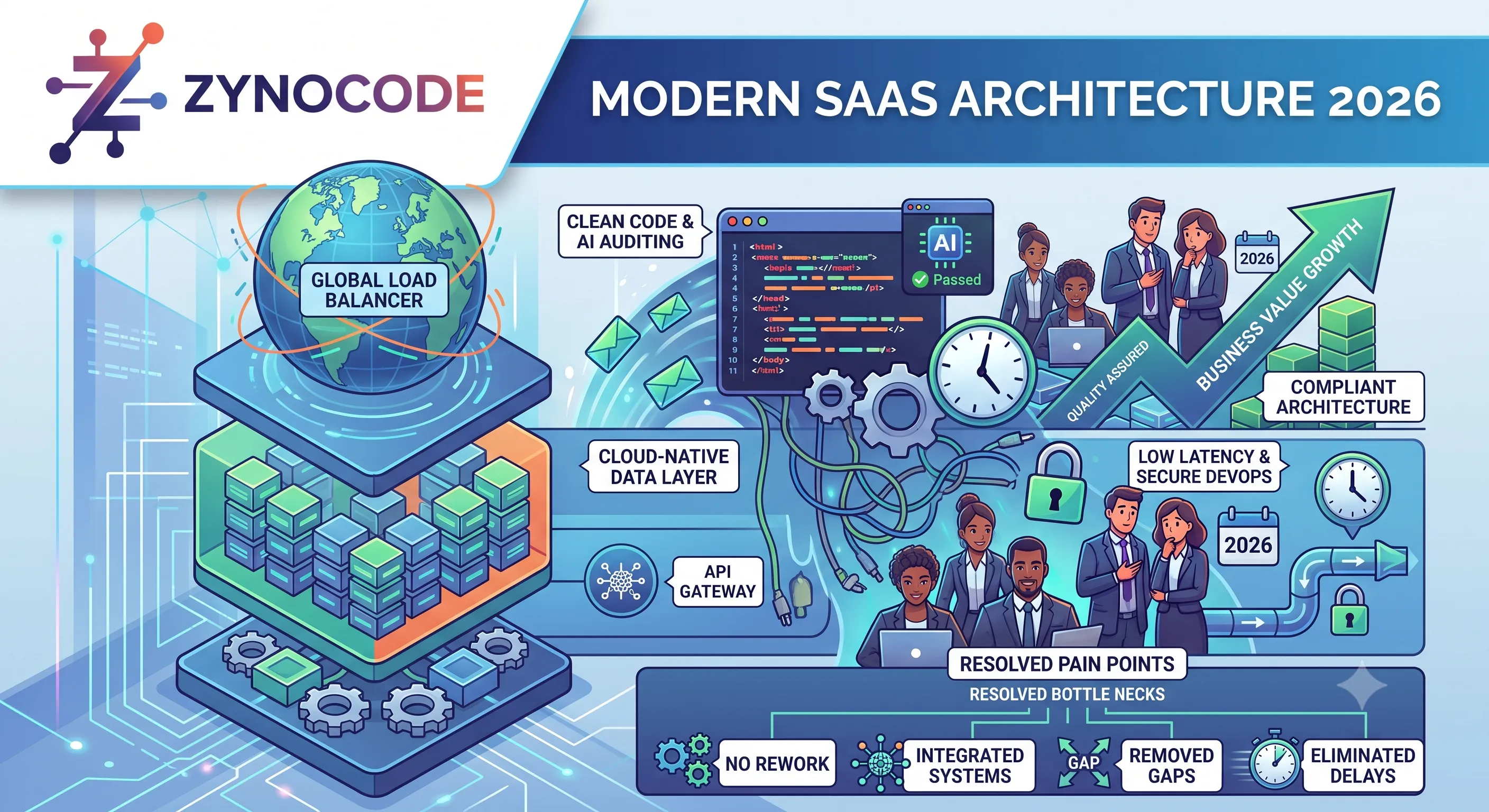
> TL;DR: Modern SaaS architecture in 2026 leverages serverless-first, AI-native edge rendering using frameworks like Next.js to deliver sub-second latency. By decoupling frontend interfaces from backend microservices and using React Server Components, engineering teams can significantly reduce infrastructure costs while scaling effortlessly.
> TL;DR: Modern SaaS architecture in 2026 demands a shift toward serverless-first, AI-native edge rendering using frameworks like Next.js App Router. By decoupling heavy processing from the client and prioritizing vector-ready databases, engineering teams can build scalable platforms that deliver sub-second latency and intelligent data retrieval natively.
What is Modern SaaS Architecture?
Definition: Modern SaaS architecture is a cloud-native software design paradigm that utilizes serverless compute, edge networks, and AI-ready data layers to deliver highly scalable, multi-tenant applications.
Modern SaaS architecture is a cloud-native software design paradigm that leverages serverless compute, edge networks, and AI-ready data layers to deliver highly scalable, multi-tenant applications. Unlike traditional monolithic systems, it prioritizes decoupling frontend interfaces from microservices to ensure rapid feature deployment and isolated fault tolerance.
Why Modern SaaS Architecture Matters Today As digital transformation accelerates, user expectations for performance and intelligence have skyrocketed. A rigid, legacy architecture simply cannot keep up with the demands of AI integration, global user bases, and real-time processing.
The Cost of Legacy Systems Companies running outdated SaaS models often face ballooning server costs, sluggish load times, and massive technical debt. These bottlenecks cripple innovation, making it nearly impossible to rapidly deploy new features or integrate generative AI without complete system overhauls.
The Competitive Edge of 2026 Architectures By adopting the latest paradigms—such as Turbopack for lightning-fast builds and React Server Components—businesses can reduce infrastructure overhead by up to 40%. A modern stack ensures that your application remains resilient, secure, and ready to scale effortlessly as your user base grows.
How Modern SaaS Architecture Works The blueprint for 2026 relies on a meticulously layered approach that separates concerns while maintaining fluid data flow across the stack.
Edge Rendering and Compute Instead of relying on a centralized server farm, modern architectures push compute to the edge. This means executing logic and rendering UI components geographically closer to the user, drastically reducing Time to First Byte (TTFB) and improving core web vitals.
AI-Native Data Layers and Vector Databases Data is no longer just stored; it is embedded and made semantic. By integrating vector databases (like Pinecone or MongoDB Atlas Vector Search) alongside traditional relational databases, SaaS platforms can support instant similarity searches, RAG (Retrieval-Augmented Generation), and context-aware AI agents natively.
Practical Steps to Upgrade Your SaaS Architecture Transitioning to a modern architecture doesn't require burning down your existing codebase. Instead, follow a phased modernization approach:
- 1Adopt a Meta-Framework: Migrate your frontend to Next.js using the App Router. This enables React Server Components, moving heavy data fetching to the server.
- 2Decouple the Backend: Break down your monolith into focused microservices or serverless functions deployed on platforms like Vercel or AWS Lambda.
- 3Implement Edge Caching: Utilize advanced caching strategies and edge networks (like Cloudflare or Vercel Edge) to serve static assets and cached API responses instantly.
- 4Prepare for AI: Introduce a vector database to your stack and begin embedding your application's core data to unlock generative AI features.
Common Mistakes When Architecting a SaaS Platform Even experienced engineering teams can fall into traps when designing modern systems. Avoid these frequent pitfalls:
- Over-Engineering Too Early: Don't adopt a complex microservices mesh if a well-structured monolith or simple serverless setup will suffice for your current scale.
- Ignoring Database Connection Limits: Serverless functions can exhaust traditional database connections quickly. Always implement connection pooling (e.g., using PgBouncer) or use connectionless database drivers.
- Neglecting Edge Security: Pushing logic to the edge means a wider attack surface. Ensure robust authentication, rate limiting, and zero-trust policies are enforced at every endpoint.
Frequently Asked Questions (FAQ)
What is the best framework for modern SaaS architecture? Next.js using the App Router is currently the industry standard for modern SaaS. It natively supports React Server Components, edge rendering, and advanced caching, making it ideal for scalable, high-performance applications.
How does AI change SaaS software architecture? AI requires SaaS architectures to support semantic search and real-time inference. This means integrating vector databases for embeddings and ensuring your API layer can handle asynchronous, long-running AI generation tasks efficiently.
What is edge computing in SaaS? Edge computing runs application logic and renders content on servers geographically close to the user rather than in a single central data center. This drastically reduces latency and improves the user experience.
Why should a SaaS use React Server Components? React Server Components allow you to fetch data and render heavy UI elements on the server, sending only lightweight HTML to the browser. This reduces client-side JavaScript bundles and significantly boosts page load speeds.
How do I scale a multi-tenant SaaS database? Scale multi-tenant databases by using row-level security (RLS) or database sharding to isolate tenant data. Coupling this with robust connection pooling ensures high performance even during massive traffic spikes.
Conclusion The SaaS landscape of 2026 is defined by speed, intelligence, and scalability. By transitioning to edge compute, leveraging Next.js App Router, and integrating AI-native data schemas, businesses can future-proof their platforms. Partnering with a specialized engineering pod like Zynocode ensures your architecture is built to dominate the market without the burden of technical debt.
Dive deeper into our sibling spoke: B2B Wholesale Portals for Jodhpur Furniture Manufacturers ↗
Frequently Asked Questions

Written by Prashant Sharma
Founder & Technology StrategistPrashant Sharma is the Founder & CEO of Zynocode IT Solutions. As a seasoned tech visionary, software architect, and digital growth consultant, he leads enterprise engineering strategies, high-performance web systems, and custom AI implementations. Under his leadership, Zynocode has built a reputation as the premier website development company in Jaipur and a trusted AI automation agency in Jaipur delivering high-end solutions globally. For a detailed breakdown of his professional career and technical achievements, visit his dedicated Founder Profile page.
Related Services
Related Articles
B2B Wholesale Portals for Jodhpur Furniture Manufacturers
Read article →Web DevelopmentShopify Website Developer Jaipur: Build Your Store
Read article →Web DevelopmentExpert MVP Development Jaipur Services for Startups & SMBs
Read article →Web DevelopmentLocal SEO Jaipur: Dominate Local Search With
Read article →Free Tools from Zynocode Labs
100% in-browser • Zero server uploads • No account required
Client-Side Image Compressor
Compress WebP, PNG, and JPEG assets in-browser for 100/100 Core Web Vitals.
SVG Optimizer & Minifier
Clean unneeded XML attributes and minify SVG icons for fast web delivery.
JSON Formatter & Schema Validator
Format, validate, and inspect JSON-LD structured data and API responses.