Software Development

MVP Development Cost in 2026: Complete Pricing Guide ($5K–$150K)

Prashant Sharma
By Prashant SharmaFounder & Technology Strategist
Published:

Credentials: Founder of Zynocode IT Solutions. Expertise in enterprise architecture, Next.js, and business automation.
MVP Development Cost in 2026: Complete Pricing Guide ($5K–$150K)

Key Takeaways

  • Simple MVP (1–3 features): $5K–$15K | 2–4 weeks development timeline.
  • Mid-complexity MVP (5–8 features): $25K–$60K | 6–12 weeks development timeline.
  • Complex MVP (marketplace, AI, multi-platform): $80K–$150K | 12–24 weeks development timeline.
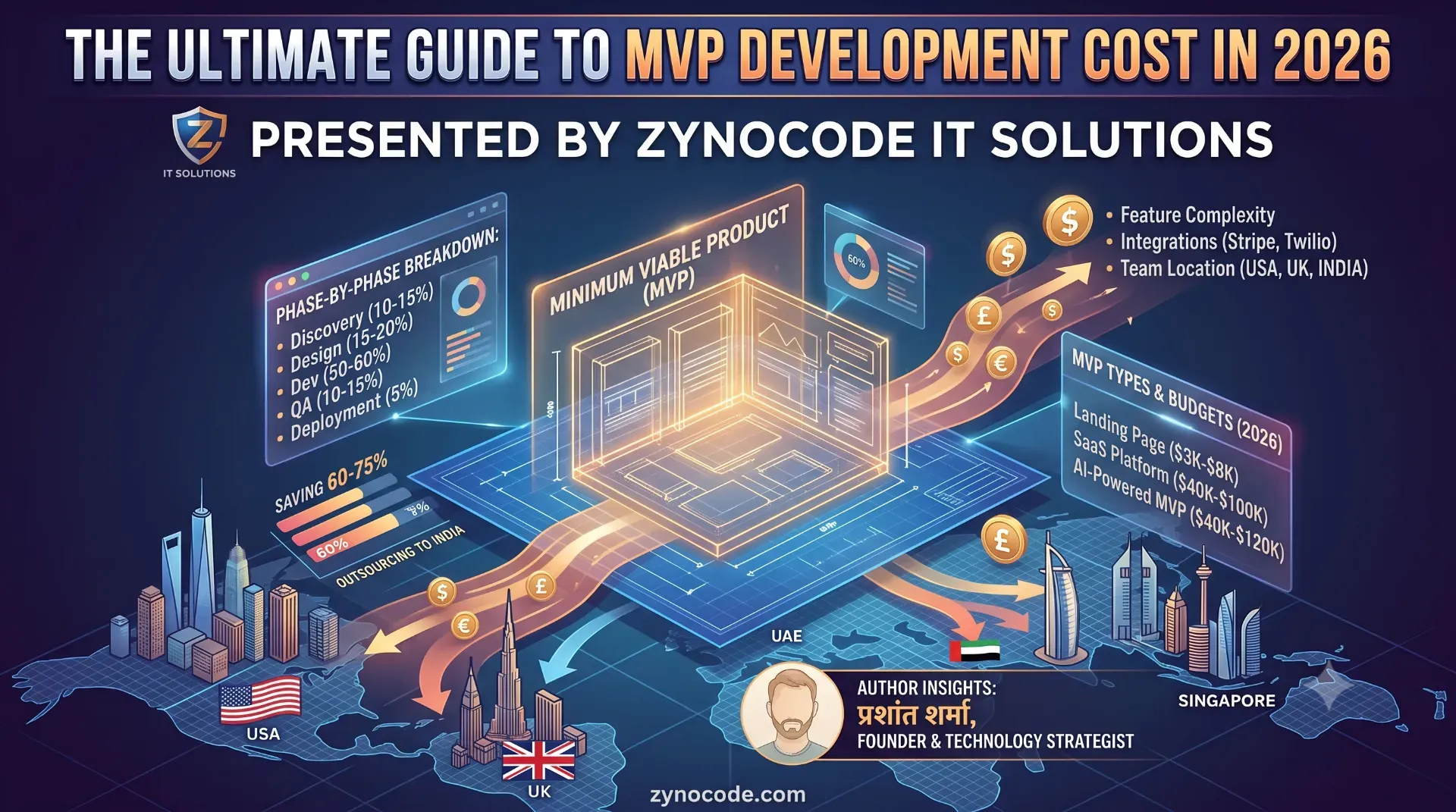
  • Outsourcing to India: Saves 60–75% compared to US-based development without compromising core engineering quality.
  • Post-launch maintenance: Requires budgeting an additional 15–20% of the initial build cost annually.

The average MVP development cost in 2026 ranges from $5,000 to $150,000. A simple single-feature MVP costs $5K–$15K. A mid-complexity MVP with 5–8 features costs $25K–$60K. A complex MVP with AI, multi-platform support, or marketplace functionality costs $80K–$150K. These costs vary significantly by development team location — the same MVP costing $80K in the USA can be built for $20K–$35K in India without quality compromise. According to data from CB Insights, 42% of startups fail because they build products with zero market need. Developing a Minimum Viable Product (MVP) mitigates this exact structural risk by verifying market demand before committing significant capital.

---

What Determines MVP Development Cost?

Estimating the cost to build an MVP requires evaluating specific engineering choices, functional architecture, and organizational operational models. In our experience building 50+ MVPs at Zynocode IT Solutions, pricing is never arbitrary. It is a direct mathematical derivation of engineering hours multiplied by the hourly rate of your chosen development team. Six core technical variables directly dictate the ultimate financial outlay.

Feature Complexity The absolute volume and technical depth of features represent the most substantial cost driver. A feature is not simply a visual element on a screen; it requires database schema design, application business logic, API endpoints, and comprehensive unit testing. Simple text-based features require minimal data serialization. Complex real-time features require persistent server connections, operational data synchronization, and heavy computational architecture.

Technology Stack Selection Your engineering ecosystem dictates both immediate development speed and future maintenance overhead. According to the StackOverflow Developer Survey 2026, modern frameworks like Next.js, Node.js, and TypeScript offer the highest velocity for web applications due to vast open-source module ecosystems. Selecting niche, legacy, or highly specialized languages increases developer hourly rates due to talent scarcity, directly expanding the overall product budget.

Development Team Location Geographic location is the single largest variable impacting the total capital required for software engineering. Software engineering capabilities are globally distributed, but local cost-of-living standards create stark hourly rate disparities. A senior full-stack engineer in San Francisco commands premium market compensation, whereas an engineer with identical technical capabilities and certifications in India operates at a structural cost reduction due to regional economic dynamics.

Design Requirements (Template vs Custom UI/UX) User experience engineering directly impacts front-end layout time. Utilizing pre-built component frameworks like Tailwind UI or Material Design reduces design and front-end implementation time by up to 60%. Conversely, custom UI/UX design requires specialized Figma wireframing, iterative user journey mapping, custom component assembly, and complex CSS styling, which adds significant hours to the frontend bill.

Third-Party Integrations (Stripe, Twilio, AWS, etc.) Integrating third-party APIs accelerates speed-to-market but requires custom wrapper development, authentication configuration, webhook processing, and rigorous error handling. While basic integrations like a standard Stripe Checkout page take fewer engineering hours, complex configurations like multi-tenant marketplace checkouts or real-time Twilio video streaming necessitate deep architectural integration and extended quality assurance cycles.

Platform Choice (Web Only vs Mobile vs Cross-Platform) Deploying a web application involves single-codebase optimization for modern desktop and mobile browsers. Launching native mobile applications requires separate iOS (Swift) and Android (Kotlin) engineering pipelines, doubling development costs. Cross-platform frameworks like React Native or Flutter bridge this gap, allowing a single codebase to output to both mobile operating systems, which reduces multi-platform mobile deployment budgets by roughly 40%.

Cost Factors Impact Matrix

Cost FactorLow Impact ($)Medium Impact ($$)High Impact ($$$)
Features (1–3 core)$5K–$15K
Features (4–8 core)$25K–$60K
Features (9+ with integrations)$80K–$150K
Template-based design$1K–$3K
Custom UI/UX design$5K–$15K
Premium design with animations$15K–$30K
Each API integration$500–$2K$2K–$5K$5K–$15K

---

MVP Development Cost by Type

The architectural framework of your application dictates the structural engineering complexity. A simple transactional application requires vastly different engineering resources than a distributed multi-tenant software system or an asynchronous machine learning pipeline. Here is the operational breakdown of MVP development cost by product category in 2026.

Landing Page MVP — $3K–$8K * **Timeline:** 2–4 weeks * **Famous Example:** Dropbox (started with a simple explainer video and email capture page) * **Best For:** Early-stage founders validating market interest, value propositions, and initial user acquisition costs before writing backend application code. * **Technical Scope:** High-fidelity custom frontend landing page, functional email capturing mechanism via Mailchimp or HubSpot API, analytical tracking (Google Analytics, Hotjar), and a structural product explainer layout.

Single-Feature Web App — $8K–$20K * **Timeline:** 4–8 weeks * **Famous Example:** Basecamp v1 (started purely as a simple project management tool without complex billing or sub-features) * **Best For:** B2B startups seeking to prove operational utility for a single specific business workflow or acute workflow pain point. * **Technical Scope:** Relational database storage, basic user registration/authentication (OAuth 2.0 or NextAuth), one primary functional workspace dashboard, and a core utility feature (e.g., generating a specific PDF report or processing a specific data upload).

Mobile App MVP (iOS or Android) — $15K–$40K * **Timeline:** 6–12 weeks * **Famous Example:** Instagram v1 (started as Burbn, a simple photo-sharing app focused exclusively on filters and image uploads) * **Best For:** B2C product concepts reliant on native mobile device hardware permissions such as geolocation, camera access, push notifications, or local storage. * **Technical Scope:** Cross-platform React Native/Flutter codebase, push notification server infrastructure (Firebase Cloud Messaging), geolocation tracking API integration, media optimization pipeline, and basic profile configuration views.

Marketplace MVP (Two-Sided Platform) — $30K–$80K * **Timeline:** 8–16 weeks * **Famous Example:** Airbnb v1 (started as a simple listing website for design conference attendees to rent air mattresses) * **Best For:** Startups connecting distinct supply-side vendors with demand-side consumers within a unified transaction hub. * **Technical Scope:** Dual user authentication flows (buyer vs. seller roles), comprehensive product/service catalog search with filtering, direct Stripe Connect integration for escrow and split payouts, messaging system, and an order management control center.

SaaS Platform MVP — $40K–$100K * **Timeline:** 10–20 weeks * **Famous Example:** Slack v1 (started as an internal communication tool carved out of a failing gaming startup) * **Best For:** Enterprise B2B software companies targeting recurring subscription revenues through workflow automation, analytics, or team collaboration utilities. * **Technical Scope:** Multi-tenant database partitioning, granular role-based access control (RBAC), multi-tier Stripe billing engine, operational dashboard metrics, historical data logging, and comprehensive data export capacities.

AI-Powered MVP — $40K–$120K * **Timeline:** 12–24 weeks * **Famous Example:** Jasper AI v1 (started as a thin wrapper tool around early OpenAI foundational models before scaling out proprietary training layers) * **Best For:** Technology companies integrating specialized machine learning models, large language models (LLMs), or predictive analytics into user workflows. * **Technical Scope:** Asynchronous API queuing pipelines, PGVector database engine for retrieval-augmented generation (RAG), prompt engineering middleware orchestration, LLM token caching mechanisms, usage-based consumption tracking, and secure vector ingestion pipelines.

MVP Cost by Type Summary

MVP TypeCost RangeTimelineFamous ExampleBest For
Landing page + waitlist$3K–$8K2–4 weeksDropboxIdea validation
Single-feature web app$8K–$20K4–8 weeksBasecamp v1B2B SaaS testing
Mobile app (single platform)$15K–$40K6–12 weeksInstagram v1Consumer apps
Cross-platform mobile app$25K–$60K8–14 weeksUber v1On-demand services
Marketplace$30K–$80K8–16 weeksAirbnb v1Two-sided platforms
SaaS platform$40K–$100K10–20 weeksSlack v1Enterprise/B2B SaaS
AI-powered product$40K–$120K12–24 weeksJasper AI v1AI-first products

---

MVP Development Cost by Country

Global economic conditions directly dictate development pricing variations. A software developer's hourly wage is fundamentally bound to the cost of living and localized commercial real estate overhead within their specific jurisdiction. According to validated agency data compiled by Clutch.co, development firms command starkly different price ranges based entirely on regional placement.

North American agencies located in the USA or Canada charge top market premium pricing ($150–$250/hr). Western Europe follows a similar structure ($80–$150/hr). Eastern European tech hubs (Poland, Ukraine) and Latin America ($35–$80/hr) offer reduced rates.

India continues to represent the strategic global sweet spot for custom software engineering. The nation hosts the largest aggregated concentration of engineering and computer science graduates globally. Due to optimal regional operational costs, a premier software development partner in India can field highly certified engineering teams at an hourly billing rate of $25–$50.

Understanding the broader context of Custom Software Development Cost India highlights exactly why global founders deploy offshore product engineering to maximize available capitalization. Utilizing a strategic approach on How to Outsource Web Development to India enables software founders to bypass domestic recruitment delays and access immediately deployable production engineering units.

Global Rate Comparison Table

Country/RegionHourly Rate RangeSimple MVP ($)Complex MVP ($)Quality
USA$150–$250/hr$45K–$75K$120K–$250K⭐⭐⭐⭐⭐
UK$100–$200/hr$35K–$60K$100K–$200K⭐⭐⭐⭐⭐
Western Europe$80–$150/hr$25K–$50K$80K–$150K⭐⭐⭐⭐⭐
Eastern Europe (Poland)$40–$80/hr$15K–$30K$50K–$80K⭐⭐⭐⭐
Latin America (Mexico)$35–$65/hr$12K–$25K$40K–$70K⭐⭐⭐⭐
India$25–$50/hr$5K–$15K$25K–$60K⭐⭐⭐⭐
Southeast Asia (Vietnam)$20–$40/hr$5K–$12K$20K–$45K⭐⭐⭐

*At Zynocode, our MVP projects typically fall in the $15K–$45K range for mid-complexity products, with teams including a project manager, 2 full-stack developers, a UI/UX designer, and a QA engineer.*

---

MVP Development Cost Breakdown by Phase

Software engineering is an orderly, multi-stage discipline. The financial resources allocated to an MVP are distributed carefully across specific technical phases, preventing architectural mistakes and ensuring alignment between user requirements and product delivery.

1. Discovery & Requirements Allocation (10–15%) This strategic phase prevents scope creep by establishing strict engineering boundaries. Technical analysts write the Product Requirement Document (PRD), construct data flow maps, compile comprehensive functional user stories, and lay out basic structural wireframes.

2. UI/UX Design Phase Allocation (15–20%) Design transforms conceptual architecture into tangible user interfaces. UI/UX designers construct interactive design systems, custom typography layout grids, and deliver verified high-fidelity interactive prototypes inside Figma.

3. Frontend & Backend Development Allocation (50–60%) Engineering forms the core infrastructure. Frontend developers write clean, modular component structures using frameworks like React or Next.js. Backend engineers architect secure relational database schemas, construct scalable business logic microservices, implement tokenized authentication (JWT/OAuth), and build API layers (REST/GraphQL).

4. Testing & Quality Assurance Allocation (10–15%) QA ensures that your application runs smoothly under real-world conditions. QA engineers run automated unit tests, write end-to-end integration test profiles, carry out manual cross-browser testing matrices, and execute performance load tests.

5. Deployment & DevOps Allocation (5%) DevOps transforms raw codebase repositories into active, accessible web environments. Engineers configure secure production environments within cloud systems like AWS or Google Cloud, establish automated continuous integration and deployment (CI/CD) pipelines, and apply SSL encryption.

Phase-by-Phase Cost Breakdown Table

Development Phase% of Total BudgetSimple MVP ($)Complex MVP ($)Key Deliverables
Discovery & Requirements10–15%$500–$2K$8K–$20KPRD, user stories, architecture wireframes
UI/UX Design15–20%$1K–$3K$12K–$25KMockups, clickable prototype, design system
Frontend Development25–30%$2K–$5K$20K–$40KResponsive UI components, state management
Backend & API Dev25–30%$2K–$5K$20K–$40KAPIs, database schema, auth, business logic
Testing & QA10–15%$500–$2K$8K–$18KUnit tests, integration tests, E2E validation
Deployment & DevOps5%$300–$1K$4K–$8KCI/CD setup, cloud hosting, log monitoring

---

Technology Stack Impact on MVP Cost

The specific technological frameworks selected for your application dictate long-term developer resource efficiency, database operations costs, and infrastructure scaling overhead.

For modern B2B SaaS frameworks, the unified JavaScript/TypeScript stack (Next.js, Node.js, and PostgreSQL) remains highly efficient. Using a single language across both frontend and backend domains allows a single full-stack engineer to build out complete features end-to-end. Understanding the broader context of SaaS Development Cost in India demonstrates how picking a mainstream, widely supported tech stack keeps development rates accessible.

For consumer mobile apps, selecting a cross-platform framework like React Native or Flutter over native iOS and Android development cuts immediate front-end code requirements nearly in half. Combined with a serverless backend layer like Firebase, this ecosystem drops monthly runtime infrastructure fees down to minimal operational baselines.

Tech Stack Recommendation by MVP Type

MVP TypeRecommended StackWhyMonthly Infra Cost
B2B SaaSNext.js + Node.js + PostgreSQLSEO-friendly, server-side rendering, relational data consistency$50–$200/mo
Consumer Mobile AppReact Native/Flutter + FirebaseCross-platform, fast component development, low infra cost$25–$100/mo
MarketplaceNext.js + Node.js + Postgres + StripeTwo-sided account logic, payments, structured search index$100–$400/mo
AI ProductPython + FastAPI + Vector DB (Pinecone)ML pipeline support, fast asynchronous LLM integration$200–$1K/mo
Data-heavy AppPython + Django + PostgreSQL + RedisHeavy background data processing, multi-level caching$100–$500/mo

---

Hidden Costs Most Startup Founders Miss

The initial application code invoice represents only a portion of the long-term capital required to launch and sustain a software product. We always advise our clients to budget an additional 25–30% beyond development cost for these hidden expenses.

  • Third-Party Service Fees: Stripe takes 2.9% + $0.30 per transaction. Twilio bills per SMS dispatched. Cloud hosting platforms like AWS or GCP charge dynamically based on server computation time and data egress.
  • Post-Launch Maintenance: Software requires ongoing updates. Annual maintenance requires a dedicated allocation of 15–20% of the initial build budget.
  • Scaling Costs: Database read-replicas, Redis caching layers, and load balancers to distribute inbound web requests.
  • Legal and Compliance Obligations: Drafting Terms of Service, Privacy Policies, GDPR compliance, or HIPAA protocols.

---

How to Reduce MVP Development Cost Without Sacrificing Quality

Minimizing MVP costs means reducing scope while keeping engineering quality standards high.

  • Apply the MoSCoW Method: Sort proposed features into Must have, Should have, Could have, and Won't have. Ruthlessly cut everything outside "Must have".
  • Use Pre-Built Components and Libraries: Utilize Auth0/Clerk for auth, Tailwind UI/shadcn for UI, and Stripe Billing for payments out of the box.
  • Validate with a Landing Page First: Spend $3K–$5K on a high-converting landing page to collect email signups before investing $50K on custom code.
  • Hire from Cost-Effective Regions: Partner with software development agencies in India to secure senior engineering talent at a fraction of domestic costs.
  • Use Agile Sprints: Break development down into strict 2-week delivery cycles. Utilizing Agile Project Management Best Practices keeps engineering output fast and prevents scope creep.
  • Start Single-Platform: Launch a web app first before investing in separate mobile applications.

---

MVP vs Prototype vs POC — What Do You Actually Need?

Founders often use these three terms interchangeably. Choosing the wrong framework can cause you to overspend or build too little.

  • Proof of Concept (POC): An internal engineering test to verify technical feasibility (*Can this specific technical mechanism be built?*).
  • Prototype: A non-functional interactive visual model built in tools like Figma (*How does it feel to use?*).
  • Minimum Viable Product (MVP): A live, functional software application built with production-grade code (*Will customers pay for it?*).

Product Validation Framework Matrix

MetricProof of Concept (POC)PrototypeMVP
PurposeCan we build it?How will users interact?Will people pay for it?
Cost$2K–$10K$5K–$20K$10K–$150K
Timeline1–3 weeks2–6 weeks4–24 weeks
Target UsersInternal team onlyTest users / stakeholdersReal paying customers
Code QualityThrowaway codeSemi-polished / MockProduction-grade code
RevenueNoNoYes — live product
What You LearnTechnical feasibilityUX and usabilityProduct-market fit

---

Real MVP Development Case Studies

Reviewing real-world engineering project data provides clear insight into how budgets translate into business outcomes.

Case Study 1: Healthcare Booking MVP * **Client:** US-based healthtech startup * **Features:** Patient booking engine, HIPAA-compliant patient intake forms, doctor dashboard availability calendars, automated SMS reminders via Twilio API, and insurance document uploads. * **Tech Stack:** Next.js, Node.js, PostgreSQL, Twilio API, AWS S3 * **Cost:** $28,000 | **Timeline:** 10 weeks * **Result:** Processed 500+ successful doctor bookings within the first month of deployment, allowing the startup to secure a $200K seed funding round.

Case Study 2: E-commerce / Marketplace MVP * **Client:** UAE-based marketplace founder * **Features:** Multi-vendor onboarding, catalog search with category filters, customer checkout cart, multi-tenant Stripe Connect payment splitting, and automated vendor order notifications. * **Tech Stack:** Next.js, Node.js, MongoDB, Stripe Connect, AWS ECS * **Cost:** $42,000 | **Timeline:** 14 weeks * **Result:** Successfully onboarded 50 verified product vendors within 2 months of launch, reaching a Monthly Recurring Revenue (MRR) of $15K within the first 6 months.

Case Study 3: AI-Powered SaaS MVP * **Client:** UK-based SaaS startup * **Features:** Multi-model AI context processing, user dashboard, subscription tier management via Stripe, context history logging, and team workspace management. * **Tech Stack:** Next.js, Python (FastAPI), PostgreSQL, Pinecone Vector Database, OpenAI API, Stripe * **Cost:** $55,000 | **Timeline:** 16 weeks * **Result:** Attracted 200 active paying subscription users within 3 months of production deployment.

---

How to Choose the Right MVP Development Company

Selecting an engineering partner directly impacts product stability and future scalability.

  1. 1Production Portfolio: Ask for live web links to apps currently running in production, not static design images.
  2. 2Technical Depth: A quality development team will challenge your assumptions, discuss data structure trade-offs, and suggest simpler functional alternatives.
  3. 3Timezone Overlap: Require a minimum of 4 hours of daily synchronous workspace overlap.
  4. 4Engagement Clarity: Ensure transparent pricing models. Learning How to Write an RFP for a Software Project helps founders organize requirements clearly before requesting proposals.

---

Frequently Asked Questions

#### Q1: How much does a basic MVP cost?
A basic MVP costs $5,000–$15,000 in 2026. This tier covers single-feature web applications or highly polished waitlist landing pages designed to validate early market interest. The core tech stack relies on pre-built component templates and serverless cloud databases.

#### Q2: How long does it take to build an MVP?
MVP development takes 4–24 weeks, depending entirely on functional complexity. A simple single-feature validation application requires 4–8 weeks. A mid-complexity B2B SaaS system takes 6–12 weeks. Complex applications involving AI pipelines or multi-tenant marketplaces require 12–24 weeks.

#### Q3: Should I build my MVP with no-code or custom development?
Use no-code for idea validation (under $5K) if you only need to demonstrate basic user workflows or capture initial emails. However, if your software concept requires custom data algorithms, complex multi-tenant billing models, or proprietary AI features, choose custom code (Next.js and Node.js).

#### Q4: What is included in MVP development cost?
MVP cost typically covers 6 phases: discovery and PRD documentation, custom UI/UX design wireframing, frontend interface construction, backend business logic and database architecture configuration, QA testing, and deployment to secure cloud production systems with automated CI/CD.

#### Q5: How much does an MVP cost in India vs USA?
The same MVP costs 60–75% less in India compared to the USA without compromising engineering standards. A mid-complexity product that demands an $80K budget in the United States routinely prices between $20K–$35K in India ($25–$50/hr vs $150–$250/hr).

#### Q6: Can I build a functional MVP for under $10,000?
Yes — a single-feature web app MVP or landing page MVP can be built for under $10,000 by utilizing offshore development teams in India and modern pre-built UI components. Focus exclusively on one core value proposition.

#### Q7: What features should an MVP have?
An MVP should have 1–3 core features that directly solve your target user's primary pain point. Secondary features—such as exhaustive profile personalization setups or intricate messaging themes—should be pushed to later versions.

#### Q8: What is the cheapest way to build an MVP?
The cheapest approach is a landing page MVP ($3K–$5K) featuring an embedded product explainer video, clear value propositions, and an email waitlist registration form to measure market demand before spending capital on custom backend software engineering.

#### Q9: Does MVP development cost include UI/UX design?
Yes — design typically accounts for 15–20% of total MVP cost within standard agency engineering proposals. This allocation covers structural wireframes, user journey mapping, visual mockups, and interactive prototypes in Figma.

#### Q10: How much does a SaaS MVP cost?
A SaaS MVP costs $25K–$60K for a basic platform built by a professional offshore agency. This budget includes multi-tenant database security, user registration/authentication (OAuth/JWT), an operational user workspace dashboard, and recurring subscription billing (Stripe).

#### Q11: Should I hire freelancers or an agency for my MVP?
Agencies cost 20–40% more than freelancers but deliver a complete, managed engineering team including project managers, designers, full-stack developers, and QA engineers. Hiring separate freelancers often introduces project management friction.

#### Q12: What happens after MVP launch?
Post-launch, budget 15–20% of build cost annually for ongoing code maintenance, platform updates, and cloud hosting adjustments. Next steps center on analyzing user behavior data, gathering feature feedback, and prioritizing iterations.

---

Direct Project Consultation

Transform your software concept into a high-performance market asset. Zynocode has built 50+ MVPs for startups across USA, UK, UAE, and Australia, delivering exceptional engineering standards at optimal price points. Avoid the risks of unmanaged development teams or generic software configurations. Let us build a reliable, scalable foundation tailored to your business goals.

Explore our dedicated Web Applications Development services for desktop-first cloud platforms, or review our specialized Mobile App Development offerings to launch cross-platform applications. Get a free MVP cost estimate based on your specific requirements. Share your idea today and get a detailed technical proposal within 48 hours via our Contact Page.

Deep Dive SpokeLooking for practical execution insights?

Dive deeper into our sibling spoke: White-Label Web Dev: UK Agency Scaling Guide

Frequently Asked Questions

Prashant Sharma

Written by Prashant Sharma

Founder & Technology Strategist

Prashant Sharma is the Founder & CEO of Zynocode IT Solutions. As a seasoned tech visionary, software architect, and digital growth consultant, he leads enterprise engineering strategies, high-performance web systems, and custom AI implementations. Under his leadership, Zynocode has built a reputation as the premier website development company in Jaipur and a trusted AI automation agency in Jaipur delivering high-end solutions globally. For a detailed breakdown of his professional career and technical achievements, visit his dedicated Founder Profile page.