How to Write an RFP for a Software Project

Credentials: Founder of Zynocode IT Solutions. Expertise in enterprise architecture, Next.js, and business automation.
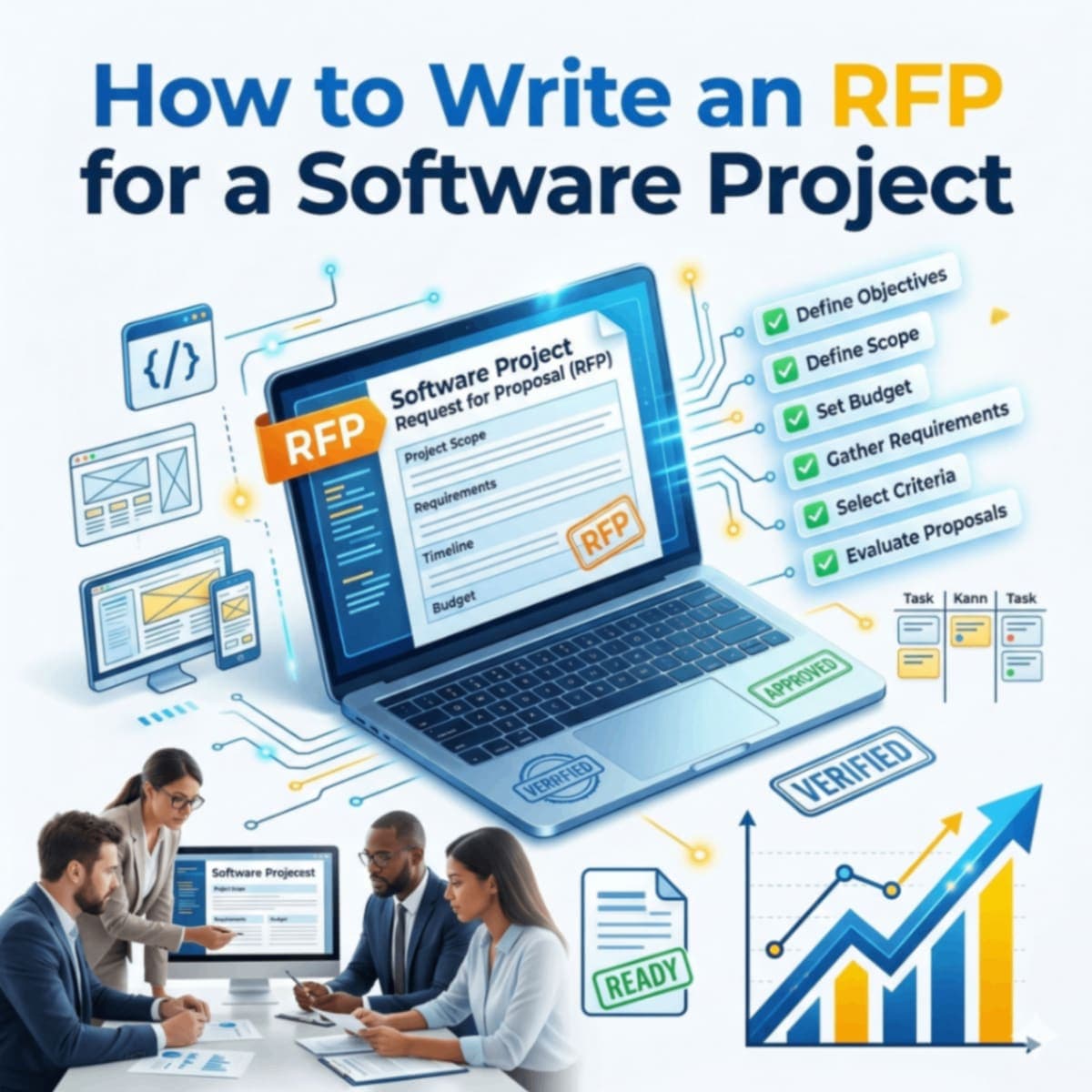
> TL;DR: Writing a software RFP involves clearly defining your project vision, detailing technical specifications, and outlining budget, timeline, and vendor evaluation criteria. This structured document aligns your business goals with technical execution, helping you attract qualified development partners while mitigating project risks. By standardizing vendor responses, you ensure an objective and cost-effective selection process.
Learning how to write RFP for software project is the foundational skill required for any business leader looking to build high-quality digital products in 2026. When you understand how to write RFP for software project effectively, you bridge the gap between your business vision and the technical execution of a development team, ensuring that every dollar spent contributes to a scalable, high-performance solution.
An RFP, or Request for Proposal, is more than just a document; it is a strategic roadmap. It tells potential vendors exactly what you need, how you expect it to function, and what success looks like for your organization. Without a clear RFP, software projects often suffer from scope creep, misaligned expectations, and significant budget overruns. In the current landscape of rapid technological shifts, specifically with AI and cloud-native architectures, the clarity of your RFP determines the quality of the partners you attract.
Why You Need to Know How to Write RFP for Software Project in 2026
In 2026, the software market has become increasingly specialized, making it vital to understand how to write RFP for software project to filter through thousands of potential agencies. According to recent data from Statista, the global software market is projected to reach unprecedented heights, leading to a crowded marketplace where every agency claims to be an expert. A well-crafted RFP acts as your first line of defense against incompetent providers.
When you invest time in professional Software Development processes, you realize that the RFP is the primary tool for risk mitigation. It allows you to standardize the responses you receive, making it easier to compare apples to apples. Instead of receiving vague pitches, you receive detailed technical solutions that address your specific pain points. This structured approach saves hundreds of hours in the long run by eliminating back-and-forth clarifications that should have been addressed in the initial document.
Furthermore, a comprehensive RFP demonstrates your company’s professionalism. Top-tier development firms are selective about the clients they take on. If your RFP is disorganized or lacks technical depth, the best agencies may pass on your project, leaving you with lower-quality options. By mastering this document, you position your project as a serious, well-thought-out venture that is worth the time of elite engineering teams.
Core Elements of a Professional Request for Proposal
Before diving into the drafting process, it is helpful to review existing resources such as our guide on How to Draft an Effective Request for Proposal (RFP) for a Software Project to understand the basic structure. At its core, a software RFP must include a project overview, company background, detailed functional requirements, non-functional requirements, and submission guidelines.
The project overview should be a high-level summary that captures the essence of what you are trying to build. Are you creating a customer-facing portal, an internal ERP system, or a complex AI-driven analytics tool? Setting the stage early helps vendors determine if they have the relevant experience to bid. Following this, the company background provides context. Vendors need to understand your industry, your competitors, and your internal culture to propose a solution that fits your specific ecosystem.
Technical requirements are the meat of the document. This is where you list every feature the software must have. However, do not just list features; describe the user journey. Instead of saying \"user login,\" describe the security protocols required, such as Multi-Factor Authentication (MFA) or Single Sign-On (SSO) integration. This level of detail prevents vendors from underquoting and then charging for \"extras\" later in the development cycle.
Detailed Steps on How to Write RFP for Software Project
To begin the process of how to write RFP for software project, you must first assemble an internal stakeholder team. This team should include representatives from the department that will use the software, IT experts, and financial decision-makers. Gathering diverse perspectives ensures that the RFP covers both the business goals and the technical constraints of your organization. This is particularly important when planning Web Application Development where user experience and backend stability must be balanced.
Once the team is assembled, the next step in how to write RFP for software project is defining the 'Problem Statement.' Don't start with the solution; start with the problem. Why is the current system failing? What manual processes need automation? By defining the problem, you allow the software vendors to use their expertise to propose innovative solutions that you might not have even considered. This collaborative approach often leads to better outcomes than a rigid list of pre-defined features.
After the problem statement, create a strict timeline for the RFP process itself. This includes the date the RFP is issued, the deadline for vendors to ask clarifying questions, the proposal submission deadline, and the expected date for the final vendor selection. Providing a clear schedule shows that your organization is organized and respects the time of the bidding agencies. It also ensures that your internal team stays on track to meet the project's ultimate launch goals.
Defining Functional and Non-Functional Requirements
One of the most common errors in software procurement is focusing solely on functional requirements while ignoring non-functional ones. To understand the financial implications of these requirements, you should check our analysis on What Are the Typical Costs for Custom Software Development in India? as technical complexity directly influences pricing. Functional requirements describe what the software *does*, while non-functional requirements describe how the software *is*.
Functional requirements might include user roles, data entry forms, reporting dashboards, and API integrations. These are the visible parts of the software. Non-functional requirements, however, include performance benchmarks, scalability, security standards, and maintainability. For example, if you are planning Mobile App Development, a non-functional requirement might be that the app must load within two seconds on a 4G connection. These specifications are often what separate a mediocre product from a world-class one.
In 2026, security and data privacy are non-negotiable. Your RFP should explicitly state compliance requirements such as GDPR, CCPA, or industry-specific regulations like HIPAA. By including these in the RFP, you ensure that the vendors include the cost of compliance in their initial bids, preventing expensive security audits and re-coding efforts later in the project lifecycle.
Evaluation Frameworks for Software Vendor Selection
Once you have distributed your RFP and received proposals, you need a systematic way to evaluate them. Using a scoring matrix is the most objective method. Assign weights to different categories based on their importance to your project. For instance, technical expertise might be worth 40% of the score, while cost accounts for 20%, and cultural fit or previous case studies account for the remaining 40%.
It is also essential to look at the methodology the vendor uses. Most modern projects benefit from the Best Practices for Agile Project Management in a Software Company (2026 Guide). If a vendor proposes a rigid Waterfall model for a complex, evolving software project, it may be a red flag. Agile allows for iterative testing and feedback, which is crucial for modern software success. Your RFP should ask vendors to describe their sprint cycles, communication tools, and how they handle changes in project scope.
Don't forget to evaluate the UI/UX Design capabilities of the bidding firms. A software project can be technically perfect, but if the interface is confusing, users will reject it. Ask vendors to provide links to live products they have built and, if possible, speak with their past clients to verify their claims of user-centric design and reliable delivery.
Budgeting and Timeline Expectations in Your RFP
Transparency regarding your budget is often a point of contention, but in 2026, it is highly recommended to provide at least a budget range. Providing a range helps vendors tailor their proposed solution to your financial reality. If you have a $50,000 budget, a vendor won't waste your time proposing a $200,000 enterprise-grade architecture. This honesty fosters trust from the very first interaction.
Timeline expectations should also be realistic. Building custom software takes time. If you demand a complex platform in six weeks, you will likely receive bids from desperate or dishonest agencies that will cut corners. A high-quality Custom Software Development Company Jaipur will provide a realistic timeline based on the complexity of your requirements. Your RFP should ask vendors to provide a detailed breakdown of the timeline, including milestones for design, development, testing, and deployment.
Finally, include a section on post-launch support. Software is never truly \"finished.\" It requires regular updates, security patches, and performance tuning. Your RFP should ask for a description of the vendor's maintenance packages and SLA (Service Level Agreement) terms. This ensures that you aren't left stranded once the initial build is complete and the software goes live for your users.
Avoiding Common Pitfalls in Software Project Proposals
Many RFP processes fail because they are either too vague or too restrictive. If you are too vague, you get inconsistent bids that are impossible to compare. If you are too restrictive, you stifle the creativity of the experts you are trying to hire. The balance lies in providing clear goals while remaining open to different technical implementations. For projects involving AI Tools & Automation, this is especially true as the technology evolves faster than most internal teams can keep up with.
Another pitfall is failing to define the 'Definition of Done.' Does 'done' mean the code is written, or does it mean the code is tested, documented, and deployed to a production environment? By clearly defining what constitutes a finished milestone, you avoid disputes over payments and project progress. This clarity is essential for maintaining a positive relationship with your chosen vendor throughout the multi-month development process.
In conclusion, mastering how to write RFP for software project is a vital investment for any business. By following a structured approach—defining your needs, setting clear technical requirements, and establishing an objective evaluation framework—you significantly increase your chances of project success. When you know how to write RFP for software project with precision, you don't just find a vendor; you find a long-term technology partner who can help your business thrive in the digital age of 2026.
Ready to turn your vision into reality? Contact Zynocode today for a consultation on your next project.
What is it? **Definition:** A software project Request for Proposal (RFP) is a structured document that details an organization's requirements, scope, and objectives to solicit competitive bids from qualified software development vendors.
Dive deeper into our sibling spoke: Hire Dedicated Next.js Developers in India: 2026 Cost & V... ↗
Frequently Asked Questions

Written by Prashant Sharma
Founder & Technology StrategistPrashant Sharma is the Founder & CEO of Zynocode IT Solutions. As a seasoned tech visionary, software architect, and digital growth consultant, he leads enterprise engineering strategies, high-performance web systems, and custom AI implementations. Under his leadership, Zynocode has built a reputation as the premier website development company in Jaipur and a trusted AI automation agency in Jaipur delivering high-end solutions globally. For a detailed breakdown of his professional career and technical achievements, visit his dedicated Founder Profile page.
⚡Recommended Architecture & Delivery Hubs
Verified Guides & PodsRelated Services
Related Articles
Hire Dedicated Next.js Developers in India: 2026 Cost & V...
Read article →Software DevelopmentMVP Development Cost in 2026: Complete Pricing Guide & Calculator
Read article →Software DevelopmentWhite Label Web Development UK: A Guide for Agencies (2026)
Read article →Software DevelopmentSaaS Development Cost in India (2026 Guide)
Read article →Free Tools from Zynocode Labs
100% in-browser • Zero server uploads • No account required
Client-Side Image Compressor
Compress WebP, PNG, and JPEG assets in-browser for 100/100 Core Web Vitals.
SVG Optimizer & Minifier
Clean unneeded XML attributes and minify SVG icons for fast web delivery.
JSON Formatter & Schema Validator
Format, validate, and inspect JSON-LD structured data and API responses.